
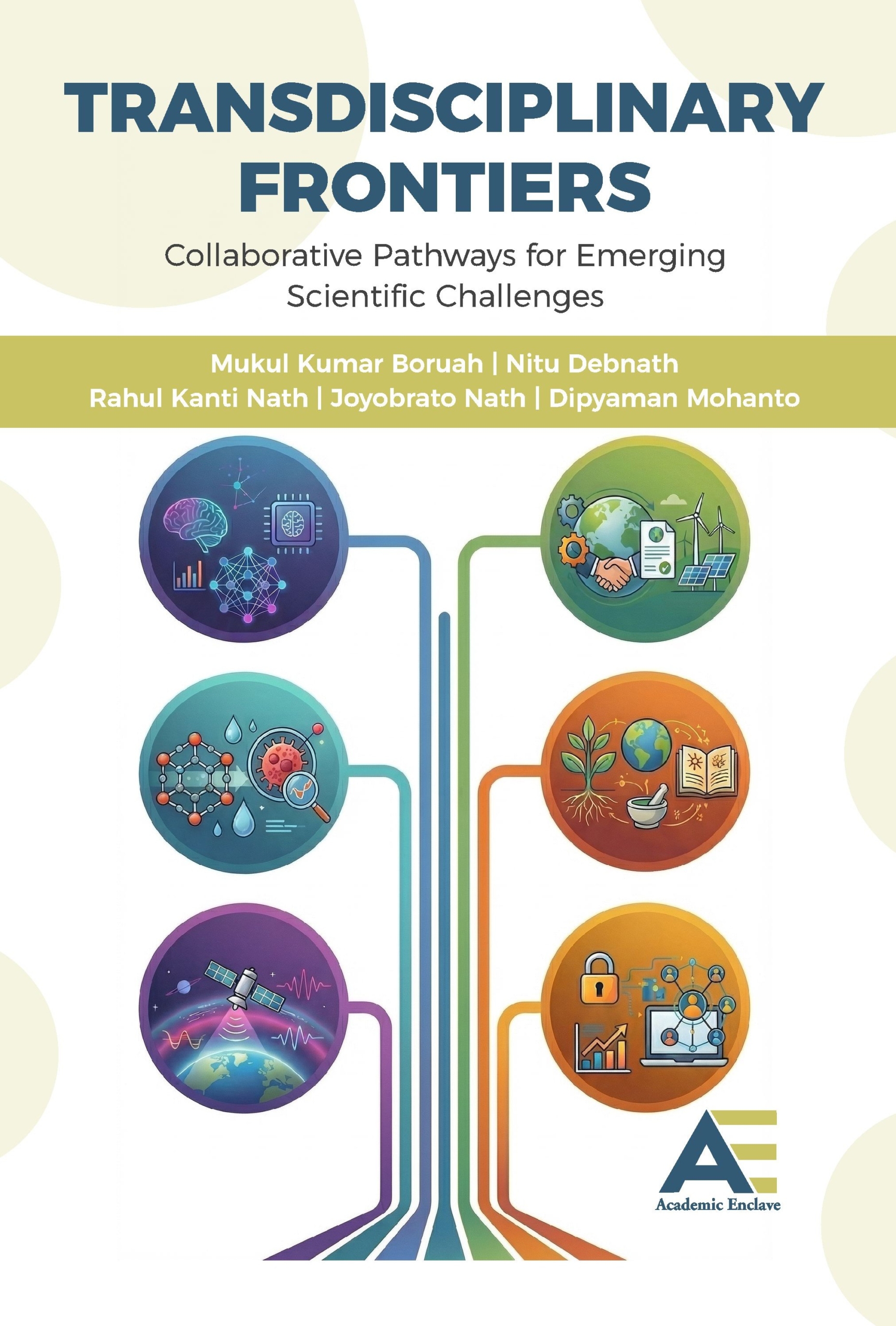
Description
Transdisciplinary Frontiers is an edited academic volume that brings together diverse scholarly perspectives exploring the evolving intersections of science, technology, sustainability, and society. The book presents a collection of research-driven chapters that move beyond traditional disciplinary boundaries, highlighting how contemporary challenges—ranging from environmental sustainability and advanced materials to computational intelligence and climate governance—require integrative and collaborative approaches.
The volume features contributions spanning metal–organic framework composites for environmental remediation, biopolymer-based nanotechnology, plasma and ionospheric studies, bioinformatics, artificial intelligence applications, and socio-economic analyses related to digital transformation and climate diplomacy. By combining experimental science, computational modelling, and policy-oriented research, the book demonstrates how transdisciplinary thinking can generate innovative solutions to complex global problems. A distinctive aspect of the work is its inclusion of regional studies from North-East India, which connect local ecological knowledge and community-based research with broader international sustainability discourses.
Designed for postgraduate students, researchers, academicians, and professionals across scientific and interdisciplinary fields, Transdisciplinary Frontiers serves as a platform for intellectual exchange. The volume aims to inspire dialogue across domains, encouraging readers to engage with emerging research frontiers that redefine the boundaries of modern scholarship.
About the Editor
Dr. Mukul Kumar Baruah, Associate Professor and Head of the Department of Botany at Cachar College, Silchar, is a distinguished scholar specialized in Angiosperm Taxonomy with research interests in floristics and ethnobotany. He earned his M.Sc. from Gauhati University and Ph.D. from Assam University, Silchar, and brings over 26 years of teaching experience. Beyond teaching, he has held key administrative positions, including Coordinator of the IQAC and multiple terms as Head of Department. As Principal Investigator, he has successfully completed projects funded by UGC-MRP, ASTEC, and the Ministry of Education, Govt. of India under the Unnat Bharat Abhiyan. Author of two books, two edited books and numerous research papers and chapters, Dr. Baruah is also active in academic community building through organizing seminars, conferences, and extensive institutional engagements across India.
Dr. Nitu Debnath is Associate Professor, Zoology, Cachar College, Silchar, Assam. Heobtained PG Degree in Zoology (Animal Physiology & Biochemistry) in 2004, (Prof. K.N Sharma Memorial Gold Medal Awardee) and PhD Degreein Zoology (2014) from Gauhati University, Guwahati. He completed Post-Graduate Diploma in Bioinformatics (PGDBI) from Assam University, Silchar (2016) and Post Graduate Diploma in Higher Education (PGDHE) from IGNOU, New Delhi (2020). His area of research interest includes Environmental Estrogen, Phytoestrogens, Environmental Endocrine Disruption and Toxicology, Bioinformatics. He completed two Research Projects under UGC and SERB(under SERB-TARE Fellowship Scheme). Currently he is the Principal Investigator of DBT-Institutional Level Biotech Hub, Cachar College, Silchar. He has 1 year of PG and 17 years of UG teaching Experience in Zoology. He has publications of Research papers, Book and Book Chapterin National & International Journals and Books in his credit.
Dr. Rahul Kanti Nath is an accomplished academic and researcher in Chemistry, presently serving as Assistant Professor in the Department of Chemistry at CacharCollege, Silchar, since May 2017. He earned both his M.Sc.(2004) and Ph.D. (2011) in Chemistry from AssamUniversity, Silchar, where he also worked as a DST-JRF ina DST-sponsored project during his doctoral research. Witha strong research interest in molecular design and materials chemistry, he haspublished widely in reputed international journals and contributed chapters toedited books. As an educator, Dr. Nath combines scholarly rigor with apassion for advancing chemical sciences through teaching, research, andacademic collaboration.
Dr. Joyobrato Nath is currently working as an Assistant Professor in the Department of Zoology at Cachar College, Silchar, Assam, India. He holds an MSc in Life Science and a PhD in Biotechnology from Assam University. Hebegan his research journey as a DBT-JRF and DBT-SRF ina DBT Twinning Project between the Molecular Parasitology Laboratory, G. C. University, Silchar and JNU, New Delhi. With over a decade of teaching and research experience, his contributions to the scientific community are exemplified by the publication of more than 20 research articles/books/ book chapters in the domains of Molecular Biology and Medical Biotechnology. His work has been published in prestigious publishing houses, like Cambridge University Press, Elsevier, Springer, PLOS, etc.
Dr. Dipyaman Mohanta is an Assistant Professor in the Department of Chemistry at Cachar College, Silchar, Assam, India. His research focuses on material chemistry, heterogeneous catalysis, and environmental and bio-sensing, with significant contributions to nanostructured materials for sustainable applications. He holds a Ph.D. in Chemistry from NIT Silchar and has qualified NET, SLET (NE), and GATE, receiving several academic distinctions including the Best Doctoral Award. Dr. Mohanta has authored more than 20 research publications with over 800 citations in reputed international journals.
Table of Contents
Preface
1. Multifunctional MOF-Based Composites for Sustainable Treatment of Metals, Organic Pollutants, and Complex Wastewater Streams
Pranjit Borah and Md. Ahmaruzzaman
2. Biopolymer Grafted Nanocomposites as Sustainable Food Packaging Material
Rebika Baruah and Archana Moni Das
3. A study on the nighttime Ionospheric Scintillation over the North-Eastern Indian Sector using GNSS techniques41
Krishna Sarkar and Atri Deshamukhya
4. Charged debris induced solitons in a plasma with kappa distributed electrons using Physics-Informed Neural Networks
Bikramjit Joardar and Madhurjya P. Bora
5. Mushrooms: Engine for Future Sustainable Living and Green Economy
Biswajit Deb Roy
6. An in silico Study of Sweet Potato, Ipomoea batatas (L.) Lam for Breast Cancer
Maitrayee Dutta Swargiary and Rossilin Suting
7. A Preliminary assessment of water quality by Phytoplankton Diversity of two beels of Kokrajhar District, Assam, India
Puja Singh Das and Jwngma Narzary
8. Ethnomedicinal Knowledge of the Tai Khamti Community in Lakhimpur, Assam: Traditional Applications of Medicinal Plants in Disease Management
Jayanta Saikia and Rajib Ratan Kashyap
9. An Assessment of State Action Plan on Climate Change in Indian Himalayan Region
Govind Ram Sankhala, Durairaj Bal asubramanian and Dharitri Borah
10. Sustainable Development Goals and Climate Diplomacy: India’s Role in Global Climate Negotiations
Sumi Das
11. Saffron Parts: A Dataset and Model-Agnostic Benchmark for Maturity-Aware Saffron Flower Detection
Heena Mushtaq Bhat, Sajid Yousuf Bhat and Mohmad Azhar Teli
12. Simulation Times of Smoke Voxels and FLIP Particles in Houdini FX
Hemaksh Gandhi
13. Robust Stacked Classifiers for Breast Cancer Outcome Prediction on WPBC Dataset197
Rahul Paul and Prithiraj Paul
14. Functional Efficiency Quality with Linear Regression for Some Software Company in India211
Sajal Kanti Das, Piya Das, Jamal Hussain and M. Sundararajan
15. Digital Financial Transformation through PFMS: Assessing Pre and Post Implementation Efficiency of Fund Flow Management in National Health Mission – A Case Study of Cachar District
Nabarupa Dhar and Parag Shil
16. Acceptability of RFID as a Security Mechanism for Girl Children: A Brief Study
Susmita Bandyopadhyay



Reviews
There are no reviews yet.